Brand Presence Intelligence, Defined
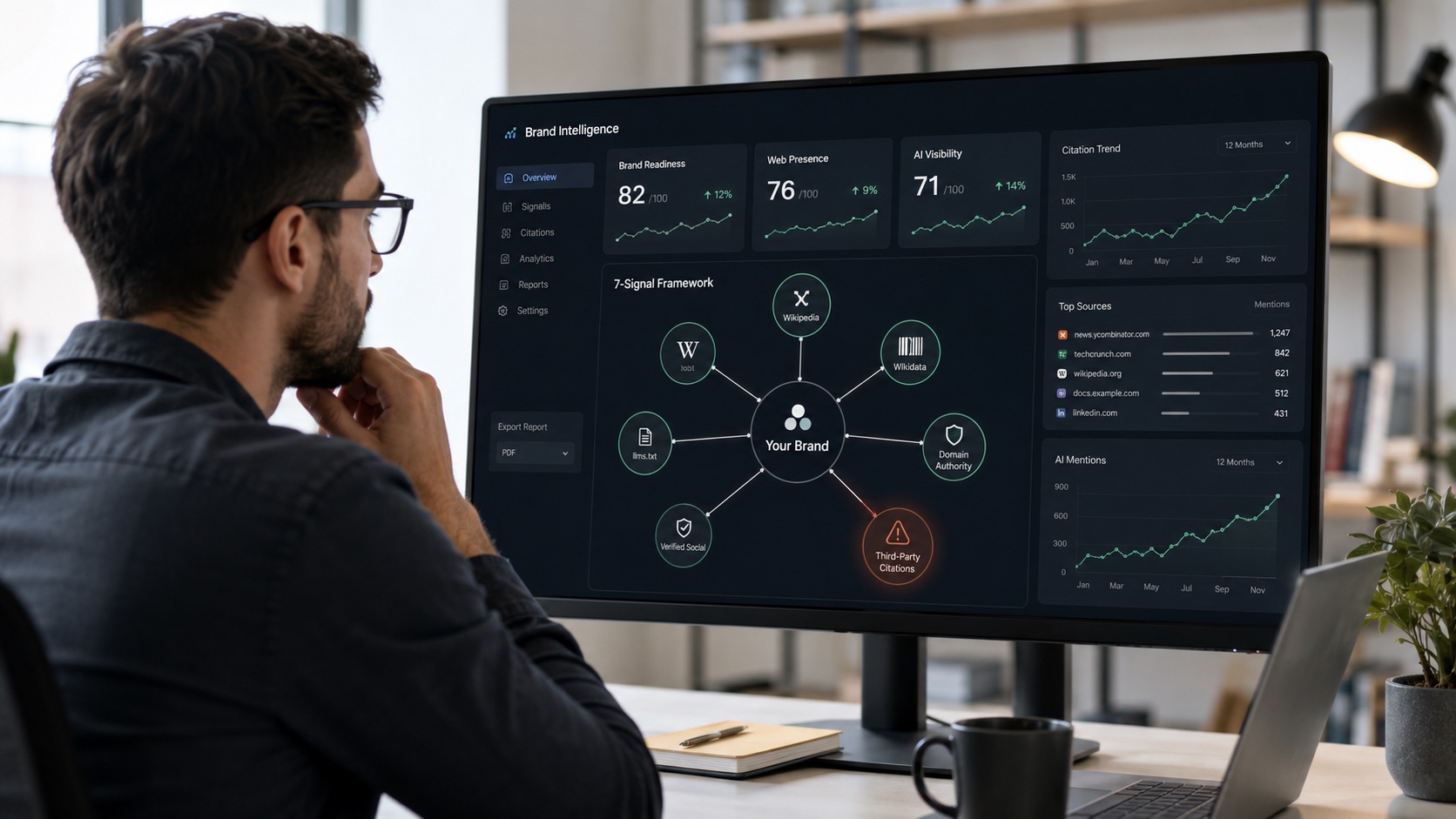
TL;DR. Brand Presence Intelligence (BPI) is the composite signal your brand emits across search engines, AI models, directories, social platforms, and citation networks, and whether those signals agree with each other. It is measured on a 7-signal framework - Wikipedia, Wikidata, domain authority, schema, third-party citations, verified social, and llms.txt - not a single score. Existing tools measure mention share, which is a symptom; BPI diagnoses the causes and fixes them. When we applied it to our own brand, DataEase AI, our weakest signal (web presence) climbed 300% in 90 days while AI visibility rose 62%. Run a free Brand Analyzer scan to see where your seven signals stand today.
We tried to use the existing labels first. None of them described what we were actually watching happen. SEO measures whether Google ranks you. GEO and AEO measure whether ChatGPT or Perplexity mention you. AI monitoring tells you what the models are saying today. Each one is a single lens, and by 2026 discovery had stopped being a single channel. So we gave the missing picture a name. This is what Brand Presence Intelligence means, why we coined it, the seven signals it measures, and the numbers from applying it to our own brand.
What is Brand Presence Intelligence?
Brand Presence Intelligence is the discipline of measuring and improving the composite signal your brand emits across every system that describes it - search engines, AI models, directories, social platforms, and citation networks - and whether those signals agree. It replaces single-lens metrics with one coherent picture of how the market sees you.
Two words carry the definition. Presence, because this is about existing credibly everywhere discovery happens, not winning one leaderboard. A brand can rank well on Google and be invisible to large language models. It can be named by ChatGPT and still have a directory footprint that screams abandoned side project. The interaction between the signals is the thing that matters, and no existing category had a word for the interaction.
Intelligence, because founders do not need another raw data feed. They need to know which signal is weakest and what to fix first. That is why we built Brand Presence Intelligence as a framework of seven signals rather than one blended number. A single score hides the diagnosis. A framework hands a solo founder a to-do list. It is the same discipline our guide to what brand presence means for founders in the AI era describes, made measurable.
Why coin a new category instead of using SEO, GEO, or AEO?
Because each existing label is a single lens. SEO measures Google rankings, GEO and AEO measure AI mentions, and monitoring tools measure today's outputs. None of them measure the chain a buyer actually travels. The gap was measuring how the signals interact, and no category had a word for that interaction.
Look at how founders actually get discovered now. A potential customer might hear about you in an AI answer, verify you on LinkedIn, check a directory listing, read a comparison post, and only then land on your website. Your brand either shows up coherently across that whole chain or it leaks trust at every step. Nobody was measuring the chain. Everyone was selling a slice. Rank trackers sold rankings. The new AI visibility tools sold mention counts inside model outputs. Social tools sold engagement.
A founder would need four dashboards and still have no answer to the only question that matters: when someone who should be my customer goes looking, do they find a brand that looks real, consistent, and credible everywhere they check? The honest version is that we invented the category because we were the customer. Running a startup alongside a day job, we had no time to reconcile five tools. We needed one picture of how the market sees the brand through every machine that now sits between us and our buyers. That picture had no name, so we named it. If you want the mechanics of why rankings and citations diverge, we broke that down in AI visibility vs traditional SEO.
What are the 7 signals of Brand Presence Intelligence?
Brand Presence Intelligence breaks presence into seven measurable signals, listed here in the order we diagnose them. Together they measure whether machines can find you, disambiguate you, trust you, parse you, corroborate you, verify you, and read you. A brand can score high on some and leak trust badly on others.
- Wikipedia presence. Whether you exist in the most heavily weighted reference source models learn from. Trust leak: a real, funded company whose only Wikipedia footprint is a deleted 2021 draft. When a model synthesizes "top tools in this category," you are simply not in the training substrate, so it recommends competitors who are.
- Wikidata entity. Whether you exist as a structured entity, not just text on pages. Trust leak: no Wikidata item, so AI systems cannot disambiguate you. Ask about "Nova" the analytics tool and the model describes Nova the energy company. You are not wrong in the answer, you are absent from it, which is worse.
- Domain authority and Tranco rank. Whether the web treats your domain as a real, established destination. Trust leak: a three-month-old domain with no inbound links. Every claim on your site is a claim only you are making, so models discount your own pricing and features and describe them vaguely or wrong.
- Schema.org structured data. Whether machines can parse what you are without guessing. Trust leak: a beautiful marketing site with zero markup. A crawler sees prose and cannot confidently extract that you are a SaaS product, in this category, at this price, while a competitor with proper Organization and Product schema gets described precisely.
- Third-party citations. Whether anyone other than you talks about you in comparison posts, listicles, reviews, and roundups. Trust leak: you appear in zero "X vs Y" content, so when a buyer asks for "alternatives to the category leader," the model assembles its answer from comparison content you were never in. Here, absence is most directly lost revenue.
- Verified social presence. Cross-platform identity consistency and legitimacy. Trust leak: a LinkedIn page with 40 followers, an X account that last posted eight months ago, and a company name spelled two different ways between them. A prospect who heard about you from an AI answer checks, sees a ghost town, and concludes the recommendation was wrong.
- llms.txt. Whether you are explicitly AI-readable through a structured, canonical statement of who you are, for models that fetch live. Trust leak: none of your positioning is machine-consumable, so retrieval-augmented answers get built from scraps of your homepage hero copy, which was written for emotion, not accuracy.
This is why we surface Brand Presence Intelligence as scores rather than a verdict. In our own product, the seven signals roll up under a Brand Readiness score, sitting alongside Web Presence and AI Visibility, and each one is tracked over time so you can watch a fix propagate. Readiness is scored across its own seven pillars, and that guide maps how the two frameworks fit together. The framework is also the backbone of our free Brand Analyzer and the wider discipline we describe on our Brand Presence Intelligence page.
Which signal do founders get most wrong?
Third-party citations, and the reason is structural, not laziness. The other six signals are controllable checklist items. You can ship schema and llms.txt in a week and verify your socials in an afternoon. Founders love those because they feel like progress. Citations are earned, slow, and require showing up in other people's content.
That includes content that compares you to competitors, which founders instinctively avoid, because "why would I want to appear next to my competitor?" That instinct is exactly backwards for AI visibility. Models synthesize category answers from comparison content. If you refuse to exist in comparisons, you have opted out of the exact material that generates recommendations. Founders over-invest in the signals they control and under-invest in the one that actually drives citation share, because the controllable ones feel like progress and the earned one feels like marketing someone else's roundup. If your brand is missing from AI answers today, this is usually the reason, which we cover in depth in why isn't my brand mentioned in ChatGPT.
Does Brand Presence Intelligence actually move the numbers?
We are running the experiment on ourselves in public. Over the last 90 days, DataEase AI's weakest signal, Web Presence, climbed 300% off a low base, AI Visibility rose 62%, and Brand Readiness sits at 72 out of 100. The dips you see are real too, because the readiness bar keeps rising as we re-measure against a moving target.
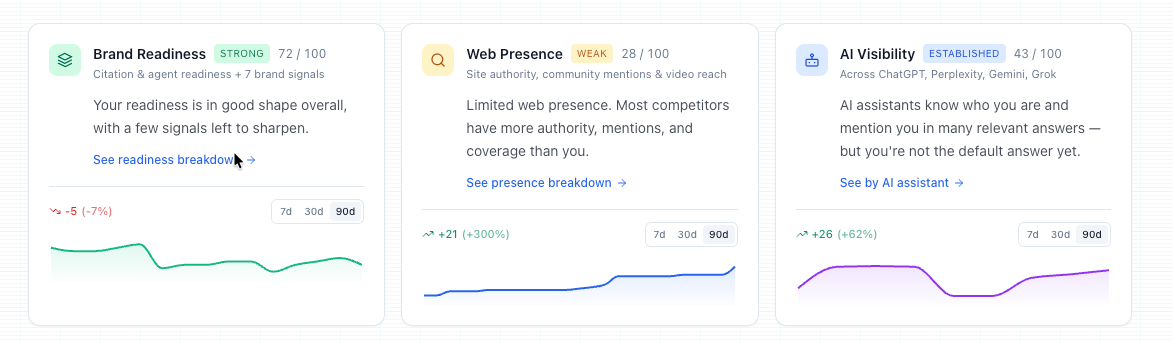
Read the three scorecards left to right. Brand Readiness is 72 out of 100 and marked strong: the entity work is in good shape, with a few of the seven signals left to sharpen. Web Presence is 28 and marked weak, because most competitors still have more site authority, community mentions, and coverage than we do. AI Visibility is 43 and marked established: assistants across ChatGPT, Perplexity, Gemini, and Grok know who we are and mention us in many relevant answers, but we are not the default answer yet. The 90-day trend on Brand Readiness reads minus seven percent, and that is not regression. The readiness bar keeps re-scoring against a tougher standard as the category matures, so a flat brand slips backward on a rising curve.
The interventions behind those numbers are all timestamped and real: migrating the blog from a subdomain into a subfolder, shipping llms.txt and schema markup, publishing flagship GEO and AEO content, submitting to SaaS and AI directories, naming the framework consistently to build citation association, and launching the analyzer with more than 2,500 brands run through it. What we deliberately have not done yet is fake a finished before-and-after. Instead we pre-registered the measurement: our top 10 target prompts are the dependent variable, run today across four engines to set a baseline, then re-run every two weeks against a dated intervention log. In 60 to 90 days that produces a genuine self-applied case study, and the thousands of brands sitting in the analyzer that took no action are a natural comparison group.
Here is the falsifiable prediction, on the record before the data lands: the move that matters most will not be the on-site fixes. It will be the third-party citation work, appearing in comparison content and roundups. "Here is my baseline, here is my prediction of which signal moves citations, watch me measure it" is a stronger asset than a polished case study, because it can be proven wrong in public.
How is this different from AI visibility tools like Profound and Otterly?
The core object is different. Almost all of the AI visibility tools, Profound, Otterly, Peec, AthenaHQ, sell measurement of a single lens: how often models mention you. That mention share is an effect, the last visible symptom of a chain of causes. Brand Presence Intelligence measures and fixes the causes across seven signals, then executes the improvements.
Selling only the symptom dashboard is the mistake the SEO industry made for fifteen years: mistaking the scoreboard for the game. A founder watches a number move up and down with no lever in their hand and gets anxiety, not agency. Those tools are also priced and designed for enterprise brand teams and agencies who have a content team to hand a report to. For a solo founder or a two-person startup, an insight you cannot execute on is just a more expensive way to feel behind.
The belief most of the category would push back on: measurement is a commodity, and the score should not be the product. Everyone is building moats around better measurement - more models polled, prettier trend lines, tighter benchmarks. That entire layer races to zero the moment the model providers or Google expose the data directly, and they will. The durable product is diagnosis plus execution: telling a founder which of the seven signals is weakest and then doing the work to fix it, autonomously, with the founder approving the high-impact moves.
The sharper version is that "AI visibility" may not even be the right frame, and we say that as a company building in it. Optimizing to be mentioned by today's models is optimizing for a moving target set by four companies whose ranking logic changes without notice, which is the SEO trap again. Brand Presence Intelligence is deliberately not "get mentioned by ChatGPT." It is building a real, coherent, machine-legible entity across every system that describes you, so that you are described correctly no matter which model, engine, or platform is doing the describing, including ones that do not exist yet. Build genuine presence and visibility in any one model becomes a lagging output you almost do not have to chase.
Where should you start with Brand Presence Intelligence?
If you run marketing or go-to-market, start with a baseline instead of a redesign. Run a free scan to see all seven signals at once, note your weakest one, and fix that first. The whole point of Brand Presence Intelligence is that it is measurement-first: you cannot improve a presence you have never measured as a whole.
The reason we point marketing and GTM teams here is that this is finally one surface instead of five. It is not only SEO, GEO, and AEO living in separate tools. It is measurement of all of it, visibility into where each signal stands, and then acting on the data - autonomously, with the founder approving the high-impact changes. That agent workforce is what turns a diagnosis into shipped fixes, and Brand Intelligence is the core surface where it runs. Run the free Brand Analyzer, read your weakest signal, and start there.
Frequently asked questions
What is Brand Presence Intelligence in one sentence?
It is the composite signal your brand emits across search engines, AI models, directories, social platforms, and citation networks, measured as an interaction of seven signals rather than a single ranking or mention count.
What are the seven signals?
Wikipedia presence, Wikidata entity, domain authority and Tranco rank, Schema.org structured data, third-party citations, verified social presence, and llms.txt. They measure whether machines can find, disambiguate, trust, parse, corroborate, verify, and read your brand.
How is it different from AI visibility tracking?
AI visibility tools measure mention share, which is a symptom. Brand Presence Intelligence measures and fixes the underlying causes across seven signals and then executes improvements, because measurement alone races to zero once model providers expose it directly.
Which signal should I fix first?
The one your scan marks weakest, but for most founders it is third-party citations. They are earned and slow, and models build category recommendations from the comparison content that founders instinctively avoid appearing in.
How do I measure it myself?
Pick your top 10 buyer prompts, run them across ChatGPT, Perplexity, Gemini, and Grok to set a baseline, and re-run the same fixed set every two weeks. Pair that citation-share trend with a Brand Analyzer scan of the seven signals.
Bottom line
Brand Presence Intelligence is not a rebrand of SEO or AI monitoring. It is the missing category that measures the whole chain a buyer travels, scored as an interaction of seven signals: Wikipedia, Wikidata, domain authority, schema, third-party citations, social verification, and llms.txt. We coined it because we were the customer with five dashboards and no coherent picture, and we are proving it on our own brand in public - Web Presence up 300% and AI Visibility up 62% in 90 days, with a falsifiable prediction that citations will be the biggest lever. The tools racing to measure mention share are optimizing a symptom on a target that moves without notice. Build real presence instead, and being named by any given model becomes a lagging output. Run a free Brand Analyzer scan, find your weakest signal, and start there.
How to cite this guide
DataEase AI. Brand Presence Intelligence, Defined. DataEase AI Blog, July 11, 2026. /blog/brand-presence-intelligence-defined/. Related reading: What Is Brand Presence?, AI Visibility vs Traditional SEO, and Why Isn't My Brand Mentioned in ChatGPT?.
See your Brand Presence Intelligence score
DataEase AI scores your brand across all seven signals, tracks how ChatGPT, Perplexity, Gemini, and Grok describe you, and shows you what to fix first.
Check your brand presence