Brand Readiness for AI Engines: The 7 Pillars Behind Every Citation
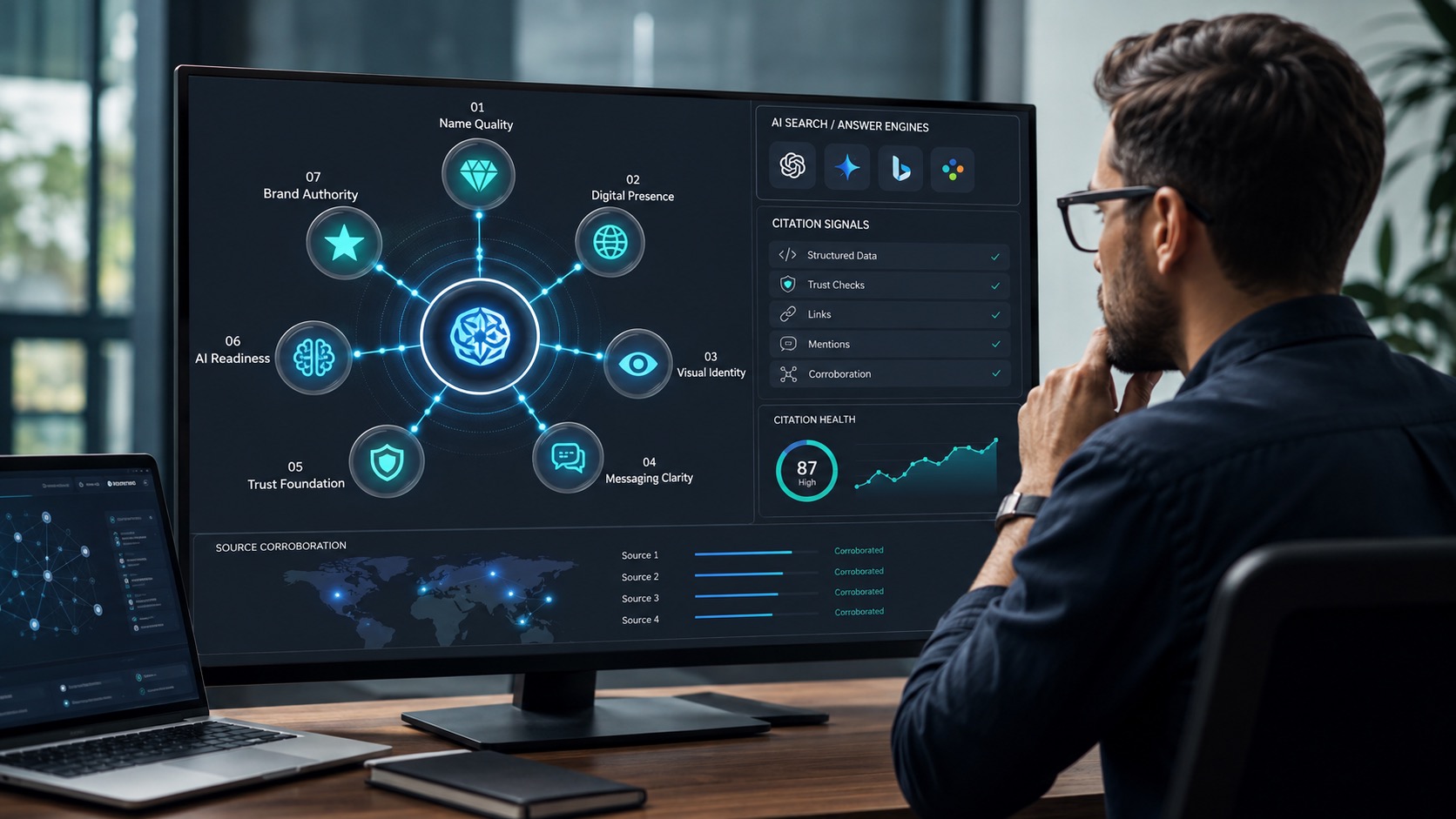
TL;DR. Brand readiness for AI engines is how completely and consistently a machine can resolve, parse, and trust your brand before it decides whether to cite you. We score it 0-100 across 7 pillars: Name Quality, Digital Presence, Visual Identity, Messaging Clarity, Trust Foundation, AI Readiness, and Brand Authority. The trap is that "AI Readiness" is only one of those seven, and it is the one founders ship first because it is a checklist. Our own Brand Readiness sits at 72 out of 100 while our Web Presence sits at 28, which is exactly the shape of a brand that did the technical work before the corroboration work. Run a free Brand Analyzer scan to see your seven pillars.
Most founders discover answer engine optimization the same way. They read that ChatGPT reads structured data, they ship JSON-LD and an llms.txt file over a weekend, they wait a month, and nothing happens. The conclusion they draw is that AEO is hype. The conclusion we draw, after running more than 2,500 brands through our analyzer, is different: the technical layer was never the blocker. It was the cheapest pillar to fix, so it got fixed first, and the six harder pillars underneath it stayed broken. This is what brand readiness for AI engines actually means, what the seven pillars measure, how they relate to the signals machines check in the wild, and what our own numbers look like right now.
What is brand readiness for AI engines?
Brand readiness for AI engines is how completely and consistently a machine can resolve, parse, and trust your brand before it decides whether to cite you. It is scored 0-100 across seven pillars and sits underneath visibility: readiness is the foundation, presence is the reach, and citations are the payoff.
The word doing the work here is "before." A model does not evaluate your content on its merits and then decide to recommend you. It first has to answer a chain of prior questions. Is this string a company? Which company? Does this company still exist? Do other sources agree with what this company says about itself? Can I extract a claim from this page precisely enough to repeat it without hedging? Every one of those questions is answered from readiness signals, not from your marketing copy. If a model cannot get past that chain, your best blog post is a rounding error.
This is why we treat readiness as a separate measurement from visibility rather than folding them into one number. Visibility tells you whether you were mentioned. Readiness tells you whether you were mentionable. Those are different failure modes and they need different fixes. We covered the full progression in our guide to what brand presence means for founders in the AI era, and readiness is the first of the three layers described there.
Why does readiness decide citations more than content does?
Because an AI engine assembling an answer is doing retrieval and synthesis under a confidence threshold, not judging writing quality. Unresolvable or uncorroborated brands get dropped before the synthesis step, so a readiness gap removes you from consideration entirely rather than ranking you lower.
Traditional search degraded gracefully. If your site was weak on one dimension you slipped from position four to position eleven, and you still existed. AI answers do not degrade gracefully. An answer names three tools, or five. There is no position eleven. When a model is uncertain whether "Nova" means the analytics tool or the energy company, the cheapest safe move is to name a brand it is certain about instead. Ambiguity does not cost you rank. It costs you the entire mention.
That is the structural difference founders underestimate. We wrote about the mechanics in AI visibility vs traditional SEO, but the short version is that SEO rewards being good and AEO rewards being unambiguous. Readiness is the discipline of being unambiguous. It is also why volume does not rescue a low-readiness brand: publishing forty posts multiplies the material a model cannot confidently attribute to you.
What are the 7 pillars of brand readiness?
The seven pillars are Name Quality, Digital Presence, Visual Identity, Messaging Clarity, Trust Foundation, AI Readiness, and Brand Authority. Each is scored independently on our 0-100 scale, because a single blended number hides which one is actually blocking you. Here is what each pillar measures and how it fails.
1. Name Quality
Can a machine resolve your name to you, uniquely, without context? This is the pillar nobody wants to hear about because by the time you are optimizing, the name is on the incorporation documents. It scores collision with existing entities, spelling variance across your own surfaces, pronounceability, and whether the name is a common noun that dissolves into ordinary text.
We live this one. Our root name collides with an open-source business intelligence tool, a Shopify app, and a desktop database product from the 1980s that still has documentation floating around the web. A model asked about "DataEase" has three plausible referents and one of them has decades of training substrate behind it. Our response is a hard internal rule: we never write the name without the AI suffix. Not in page titles, not in meta descriptions, not in image alt text, not in schema, not in body copy. Every surface says DataEase AI. That is not brand pedantry, it is entity disambiguation applied one string at a time, and it is the single highest-leverage readiness fix available to any founder with a colliding name.
2. Digital Presence
Do you exist on the surfaces machines crawl to corroborate a company, and do those surfaces agree with each other? This scores directory listings, review platforms, app marketplaces, developer registries, and social profiles, weighted by whether your name, description, category, and URL are identical across them.
The failure here is rarely absence. It is drift. A founder lists the company on six directories over eighteen months, and each listing captured the positioning of that quarter. Now a crawler finds you described as a "no-code analytics tool" on one, an "AI marketing platform" on another, and a "brand intelligence platform" on your own site. Three descriptions is not three times the coverage. It is a model with three conflicting category labels and no basis to pick one, which is functionally the same as having no category at all.
3. Visual Identity
Does the brand look like a real, consistent company at every point a human or a multimodal model looks at it? Logo presence and quality, favicon, Open Graph images, color and typography consistency across site and profiles, and whether social avatars match the site.
This is the pillar people assume is irrelevant to AI engines, and it is the one where the reasoning is most interesting. A text model does not admire your logo. But the citation loop does not end at the model. Someone reads an AI answer that names you, clicks through, and spends about four seconds deciding whether the recommendation was credible. A blank favicon, a stretched logo, and an Open Graph preview that renders as a grey box is enough to end that. Visual identity does not get you into the answer. It determines whether being in the answer converts, and increasingly whether multimodal engines that render your page treat it as a maintained property.
4. Messaging Clarity
Can a model restate what you do in one accurate sentence, using only your own pages? This scores whether you have a plain declarative positioning statement, whether your category is named explicitly, whether your audience is named, and whether the claim is extractable without inference.
Homepage hero copy is written for emotion. "Ship faster. Worry less." reads well to a human who already has context and is completely inert to a retrieval system, which extracts a fragment with no subject, no category, and no product. The fix is not to make the site boring. It is to make sure that somewhere on the page, in prose, there is a sentence a machine can lift verbatim: what you are, what category you are in, who it is for. This is the discipline behind our answer engine optimization rules, and it is why every question heading on this site is followed immediately by a direct answer rather than a warm-up paragraph.
5. Trust Foundation
Do you look like a real business rather than a landing page? HTTPS and certificate health, a privacy policy, terms of service, a contact route that is not only a form, a genuine about page with people on it, and a domain with age and stable ownership.
These read as boring compliance items and they function as liveness proofs. Models trained on the open web have absorbed an enormous amount of abandoned SaaS. The pages that signal a company still exists and answers to someone are exactly the pages that a dead project never bothered with. A missing terms page will not single-handedly cost you a citation, but the cluster of them together is the difference between a brand a model will recommend with confidence and one it hedges around.
6. AI Readiness
Is your site machine-readable on purpose? This is the technical pillar: JSON-LD structured data, Open Graph tags, meta descriptions, FAQ content, AI bot permissions in robots.txt, a clean sitemap, and an llms.txt file stating canonically who you are.
Two things are worth saying plainly. First, this pillar is genuinely necessary. Blocking GPTBot, ClaudeBot, PerplexityBot, or Google-Extended in robots.txt removes you from AI answers outright, and a surprising number of sites do it by accident through an over-broad crawler rule. Second, it is one seventh of the score. It is also the fastest to fix, the most written about, and the most satisfying to complete, which is precisely why founders mistake it for the whole job. We go deep on the implementation in our guide to building an AI-ready website. What that guide covers well is this one pillar. It does not cover the other six, and that gap is the reason this post exists.
7. Brand Authority
Does anyone other than you corroborate what you say about yourself? Third-party citations, comparison content, roundups and listicles, press, review-platform presence, and domain authority earned through genuine inbound links.
Every other pillar is a claim you make. This is the only pillar that is evidence. A model weighing whether to recommend you is weighing self-description against external description, and self-description alone gets discounted heavily. The founder instinct here is backwards in a specific way: appearing in "X vs Y" content feels like handing a competitor free exposure, so founders avoid it. But comparison content is the raw material models assemble category answers from. Refusing to appear in it is opting out of the exact corpus that produces recommendations. Our post on why your brand is not mentioned in ChatGPT works through this in detail, and the pattern held across the fifty SaaS brands in our bottom-quartile brand audit.
How do the 7 readiness pillars relate to the 7 AI visibility signals?
They are two layers of the same diagnosis. The seven pillars are the strategic layer, describing what your brand needs to be. The seven Brand Presence Intelligence signals are the evidence layer, describing what machines actually check. Pillars tell you what to fix; signals tell you where a fixer looks.
This is worth spelling out because we use both frameworks and they are easy to confuse. The seven Brand Presence Intelligence signals are Wikipedia presence, Wikidata entity, domain authority and Tranco rank, Schema.org structured data, third-party citations, verified social presence, and llms.txt. They are concrete, checkable artifacts. The seven readiness pillars are the qualities those artifacts evidence. The mapping is not one to one, and the places it breaks are the informative parts:
- Name Quality is evidenced mostly by the Wikidata entity, which is the mechanism that lets a system distinguish you from a same-named company.
- Digital Presence is evidenced by verified social presence and directory footprint, checked for consistency rather than count.
- Visual Identity has no direct machine signal. It is the one pillar measured through the human who verifies the AI answer, which is exactly why it gets dismissed and exactly why dismissing it costs conversions rather than citations.
- Messaging Clarity is evidenced by llms.txt and by extractable on-page positioning.
- Trust Foundation is evidenced by domain age, certificate health, and the trust cluster that also feeds Wikipedia notability.
- AI Readiness is evidenced by Schema.org structured data, llms.txt, and crawler permissions.
- Brand Authority is evidenced by third-party citations and by domain authority and Tranco rank.
Notice that llms.txt appears under two pillars and that Visual Identity appears under none. That is not sloppiness in the framework, it is the actual shape of the problem: some artifacts do double duty and some brand qualities are simply not machine-measurable yet. Anyone selling you a clean seven-by-seven grid is selling you a diagram, not a diagnosis.
What does a brand readiness score actually look like?
Our Brand Analyzer reports readiness in five bands: Early Stage 0-55, Developing 56-70, Brand-Ready 71-80, Strong Brand 81-90, and Iconic 91-100. Most early-stage startups land in Early Stage or Developing. That is the cold-start problem showing up as a number, not a verdict on the company.
We run the measurement on ourselves in public, so here are our numbers rather than a hypothetical. DataEase AI's Brand Readiness is 72 out of 100, which puts us just inside the Brand-Ready band. Our Web Presence is 28 out of 100 and marked weak. Our AI Visibility is 43 out of 100 and marked established. Over the last 90 days, Web Presence climbed 300% off that low base and AI Visibility rose 62%.
The interesting number is the one that went the wrong way. Our 90-day Brand Readiness trend reads minus 7%, and we did not break anything. The readiness bar re-scores against a tougher standard as the category matures, so a brand that stands still slips backward on a rising curve. We publish that figure rather than hiding it because it is the most useful thing in the dataset: readiness is not a project you complete, it is a position you hold against a moving reference.
Read the three scores together and they tell a specific story. Readiness at 72 with Web Presence at 28 is the signature of a brand that did the controllable work first. Our entity is clean, our site is machine-readable, our messaging is extractable, and almost nobody outside our own domain has corroborated any of it yet. That is not a balanced profile. It is the profile of a team that shipped the six pillars it could ship alone and is now doing the seventh the slow way. If your own scan comes back shaped like that, you are not behind on technique. You are behind on evidence, and evidence takes calendar time.
Which pillar do founders get wrong most often?
Name Quality, because it is the only pillar that cannot be fixed with a checklist once the name is chosen. Founders test names for domain availability and trademark conflict, and almost never for entity collision, which is the constraint that governs whether a model can cite them at all.
The test that should be in every naming process takes ninety seconds. Ask four engines what your candidate name is, with no context. Ask ChatGPT, Perplexity, Gemini, and Grok. If all four describe something else, you have not picked a brand name, you have picked a disambiguation problem that will follow you for years. If they describe nothing, that is fine and normal, and it is a far better starting position than colliding with an established entity.
For names already in market and already colliding, the play is not a rebrand. It is relentless qualification. Always append the modifier, everywhere, including places that feel redundant. Claim a Wikidata entity so there is a structured record distinguishing you. Get the qualified form of the name into third-party content so corroborating sources carry the disambiguation too. We have been doing exactly this for two years, and it is slow, unglamorous, and the reason our Name Quality is not the pillar dragging our score down.
How do you improve brand readiness for AI engines?
Fix in order of evidence cost, not effort. Start with a baseline scan, then work the pillars in this sequence: AI Readiness and Messaging Clarity in week one, Trust Foundation and Visual Identity in weeks two and three, Digital Presence over the following month, and Brand Authority continuously from day one because it is the only pillar with a lead time measured in months.
Two things about that ordering. First, AI Readiness comes first not because it matters most but because it is a prerequisite: there is no point earning citations to a site that blocks the crawlers reading it. Second, Brand Authority appears last in the list and starts first on the calendar. Every week you delay outreach, comparison content, and directory submissions is a week added to the end of the timeline. The other six pillars are work you can finish. This one is a pipeline you keep running.
The concrete week-one moves are unglamorous and short. Confirm GPTBot, ClaudeBot, PerplexityBot, and Google-Extended are allowed in robots.txt. Add Organization and SoftwareApplication JSON-LD. Publish an llms.txt with your canonical positioning. Write one declarative sentence on your homepage that states what you are, in which category, for whom, in plain prose a machine can lift. Standardize your brand name across every surface you control, including alt text and schema. Then re-scan and see which pillar is now the weakest, because the fix order after week one should be driven by your scan, not by this post.
Beyond the manual pass, this is the work our Brand Intelligence surface runs continuously: scoring the seven pillars, tracking each one over time so you can watch a fix propagate, benchmarking you against competitors pillar by pillar, and executing the improvements autonomously with the high-impact changes routed to you for approval. Readiness decays against a rising bar, so the useful version of this is a loop, not an audit.
How long does it take to move a brand readiness score?
On-site pillars move within days of a re-scan. Digital Presence moves in two to six weeks as listings get indexed. Brand Authority takes three to six months because citations are earned. Expect the composite score to lag your work by roughly a quarter, and expect the bar to rise underneath you while you wait.
The mistake in the waiting period is re-measuring too often and reading noise as signal. Scan at baseline, then monthly. Between scans, track the thing readiness is supposed to produce: pick your ten highest-intent buyer prompts, run them across ChatGPT, Perplexity, Gemini, and Grok, and record whether you are mentioned and cited. That prompt set is your dependent variable. Readiness is the input you are manipulating, and the citation trend is how you find out whether the manipulation worked.
Our own honest position: we are 90 days into this with a dated intervention log and a pre-registered prompt set, and the prediction we put on the record is that Brand Authority will turn out to be the pillar that moves citations most, not the technical work. That prediction is falsifiable and we will publish it either way.
Frequently asked questions
What is brand readiness for AI engines in one sentence?
It is how completely and consistently a machine can resolve, parse, and trust your brand before it decides whether to cite you, scored 0-100 across seven pillars rather than as a single technical checklist.
Is AI Readiness the same thing as brand readiness?
No. AI Readiness is one of the seven pillars and covers the machine-readable layer: schema, Open Graph, meta descriptions, FAQ content, crawler permissions, sitemap, and llms.txt. Brand readiness is the full seven-pillar score, and six of those pillars are not technical.
What is a good brand readiness score?
71-80 is Brand-Ready and indicates a strong foundation with cohesive identity. Below 56 is Early Stage and 56-70 is Developing, where most early-stage startups sit. DataEase AI's own Brand Readiness is 72 out of 100.
Can I improve readiness without a rebrand?
Yes, in almost every case. Six of the seven pillars are improvable without touching the name. Even Name Quality is usually addressable through consistent qualification and a Wikidata entity rather than a rebrand.
Does readiness guarantee AI citations?
No. Readiness makes you citable, not cited. It removes the reasons a model would skip you; earning the mention still requires Brand Authority, which is the pillar built through third-party corroboration over months.
How do I measure my brand readiness today?
Run a free Brand Analyzer scan for a 0-100 score across all seven pillars with a tier rating and specific next actions, no signup required. Pair it with a manual run of your top ten buyer prompts across four engines to set a citation baseline.
Bottom line
Brand readiness for AI engines is not the technical checklist it gets mistaken for. It is a seven-pillar measurement of whether a machine can resolve you, parse you, and trust you before it ever weighs your content, and the technical pillar is one seventh of it. The founders who conclude AEO does not work have almost always shipped that one seventh and stopped. Our own scores show the same asymmetry from the other side: Brand Readiness 72, Web Presence 28, AI Visibility 43, with readiness trending minus 7% against a rising bar. The controllable pillars are cheap and finishable. Brand Authority is neither, which is exactly why it is the one that decides whether you get cited. Run a free Brand Analyzer scan, find the pillar dragging your score, and start there.
How to cite this guide
DataEase AI. Brand Readiness for AI Engines: The 7 Pillars Behind Every Citation. DataEase AI Blog, August 7, 2026. /blog/brand-readiness-for-ai-engines/. Related reading: Brand Readiness definition, Brand Presence Intelligence, Defined, AI Brand Visibility, and Why Isn't My Brand Mentioned in ChatGPT?.
Score your brand readiness across all 7 pillars
DataEase AI scores Name Quality, Digital Presence, Visual Identity, Messaging Clarity, Trust Foundation, AI Readiness, and Brand Authority, then shows you which one to fix first.
Check your brand readiness